The numbers on a dart board
Written as one word or two, a dartboard is numbered the same way everywhere, and the order is arranged to make a narrow miss hurt. Tap any bed below to see what it scores and what missing it costs.
What are the numbers on a dartboard, in order?
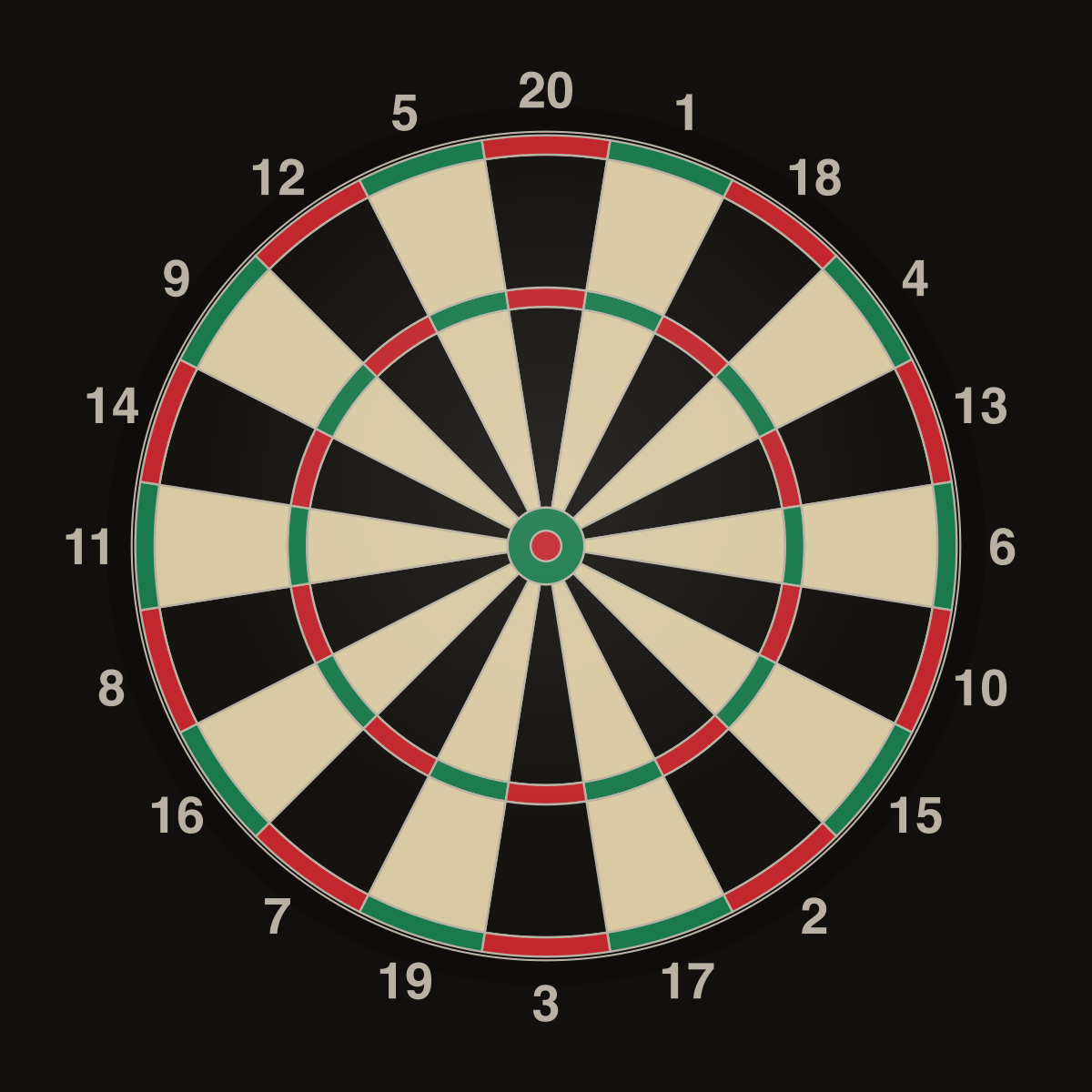
Clockwise from the 20 at the top: 20, 1, 18, 4, 13, 6, 10, 15, 2, 17, 3, 19, 7, 16, 8, 11, 14, 9, 12, 5. Every standard board uses that order, so one arranged any other way is not a tournament board.
Tap a bed
This is the same board the scorer uses, so the numbers it gives you are the numbers a game here would score.
What you tapped
60
treble 20
What a narrow miss costs
Either side of the 20 are the 5 and the 1. A dart a few millimetres wide of this bed scores 15 or 3 instead of 60.
- Hit
- 60
- Miss either way
- 9
- You lose
- 51
Clockwise from the top: 20, 1, 18, 4, 13, 6, 10, 15, 2, 17, 3, 19, 7, 16, 8, 11, 14, 9, 12, 5.
The board as a picture
The same board, drawn from the same numbers, as one image you can save or print. The tappable version above is better on a screen and no use at all pinned above a board.
Why that order
Every high number is flanked by low ones. The 20 has the 5 and the 1 beside it, the 19 has the 3 and the 7, and the 18 has the 1 and the 4. Miss by a few millimetres and the board takes almost all of it back.
That is not an impression, it is measurable. Comparing each bed with the average of its two neighbours across all twenty gives a correlation of −0.94, where 0 would mean the numbers were scattered at random and −1 would mean the highest were always beside the lowest. The board is very close to the second.
The effect is that the board rewards accuracy rather than ambition. Aiming at the 20 is only worth it if you can hit it, which is the whole reason scoring and finishing feel like two different games.
What a narrow miss costs on a dart board
Each bed against the average of the two either side of it. The low numbers are flanked by high ones, so on those a wide dart pays you rather than costing you. Every figure here is worked out from the board itself.
The five that punish you most
| Bed | Either side | You lose |
|---|---|---|
| 20 | 5 and 1 | 17 |
| 18 | 1 and 4 | 15.5 |
| 17 | 2 and 3 | 14.5 |
| 19 | 3 and 7 | 14 |
| 15 | 10 and 2 | 9 |
The three where a miss pays
| Bed | Either side | You gain |
|---|---|---|
| 1 | 20 and 18 | 18 |
| 3 | 17 and 19 | 15 |
| 2 | 15 and 17 | 14 |
This is the argument for throwing at the 19 rather than the 20 when you are still learning. The 20 is worth one more point and costs three more when you miss, and at the stage where most darts land beside the one you aimed at, that trade goes the wrong way. It is also why the treble ring magnifies everything: a treble 20 is 60 and the beds either side of it are worth 15 and 3.
Who decided the order
Nobody knows, and almost every page that answers this says otherwise.
The usual answer is Brian Gamlin, a carpenter from Bury said to have worked the order out in 1896 and to have died in 1903. It is repeated everywhere as settled fact. The trouble is that no record of him has ever been found, he filed no patent, and the numbering does not appear in print until 1916, which is a long silence for an invention that supposedly existed for twenty years.
The darts historian Patrick Chaplin went looking for Gamlin and found nothing at all. He puts the stronger case on Thomas William Buckle, a Yorkshire craftsman and domino maker, who around 1913 is thought to have adapted a London Fives board into something close to the board used today.
So the honest answer is that the order predates any reliable record of who chose it. What can be said is what it does, which is the section above, and that is checkable on any board on any wall.
Where this comes from, since almost every other page states it as settled and we are saying it is not: Patrick Chaplin on the numbering, who went looking for Gamlin and found nothing; the Traditional Games history of darts, on the single source and the missing evidence; and the Pub History Society on the Yorkshire board, for Thomas Buckle.